Though Christmas has been observed for almost two thousand years, the celebration of the holiday has gone through many permutations over the years. Many of the festive traditions we now associate with Christmas are of relatively recent pedigree, at least in their present forms: Christmas trees, Christmas crackers, Santa Claus, roast turkeys, and so forth. Today, Christmas preparations and celebrations tend to swallow up all of December, and the holiday fizzles out abruptly the day after. Then we have a week of limbo before a final blow-out on New Year’s Eve. I know I’m not alone in finding this all a little exhausting!
How did the Anglo-Saxons celebrate Christmas? Unfortunately, not much information survives. When I say ‘not much information,’ I mean that all that survives from the six hundred years of Anglo-Saxon England are vague, passing mentions in various historical writings of a midwinter holiday being celebrated, as in this well-known passage from the year 878 in the Anglo-Saxon Chronicle:
In this year in midwinter after twelfth night the enemy army came stealthily to Chippenham, and occupied the land of the West Saxons and settled there, and drove a great part of the people across the sea, and conquered most of the others; and the people submitted to them, except King Alfred. (trans. Whitelock)
As for other Old English sources, the sermons of the tenth-century preacher Aelfric of Eynsham narrate the story of the Nativity in an endearingly Anglo-Saxon way: “Hi comon ða hrædlice, and gemetton Marian, and Ioseph, and þæt cild geled on anre binne, swa him se engel cydde,” which translates, “They came then quickly, and found Mary, and Joseph, and the child laid in a bin,* as the angel had announced to them.” There is also some strikingly beautiful religious poetry that shows that the Anglo-Saxons thought and felt deeply about the theological significance of this great day—on that more below.
*The Normans had not yet invaded and changed all the bins into mangers.
The basics
Just in case we are getting ahead of ourselves, let’s go back to the very beginning. What is Christmas? It is the celebration of the birth of Jesus Christ, the Son of God by the virgin Mary, in Bethlehem, as described in the Gospels of Matthew and Luke in the Bible (the Gospels of Mark and John do not include narratives of Jesus’ birth). Although the exact date of Christ’s birth was never recorded, early in church history the feast began to be celebrated around the time of the winter solstice, the shortest day of the year, which in the northern hemisphere occurs on December 21.
In 597, the Council of Tours instituted the twelve days between December 25 and January 6 as an official feast, to be preceded by a period of fasting during Advent.
Advent
This period of Advent fasting during the darkening days of December is a factor that has been largely lost sight of in modern times. Advent was traditionally the time when Christians would remember the long centuries of waiting for the promised Messiah to come (‘advent’ means ‘coming’) and release his people from slavery to sin. In the modern world we have our ‘fast’, as it were, in January, when we try to get our lifestyle back on track after a month of indulgence.
Some of the very oldest songs now considered Christmas carols are really Advent hymns. “Of the Father’s Love Begotten,” (tune: DIVINUM MYSTERIUM) “Let All Mortal Flesh Keep Silence,” (tune: PICARDY) and “O Come, O Come, Emmanuel” (tune: VENI EMMANUEL) are three well-known examples. The words to these hymns date to the late Roman and early medieval periods, and were translated into English in the Victorian era. The haunting minor-key tunes that are now used to accompany the hymns date to the Late Medieval and Renaissance periods—so these Advent hymns represent layer upon layer of church history.
“O Come, O Come, Emmanuel” is based on the O Antiphons, advent poems in Latin probably written in Italy and dating to the sixth century. Each of these poems is a ‘cento’—a poem made up of quotations from other works, in this case Bible verses. The O Antiphons were known in the Anglo-Saxon period and inspired an ‘expanded version’ which is found in the Exeter Book. These poems explore the fulfillment of Old Testament prophecy in the birth of Christ. See Eleanor Parker’s blog for an excellent translation and discussion of these poems. https://aclerkofoxford.blogspot.com/2013/12/the-anglo-saxon-o-antiphons-o-clavis.html
Yule, Midwinter, and Christmas
Yule, or Geola (with g pronounced as y) is the old pre-Christian name for the midwinter holiday, named after the months of December-January in which it occurred. Bede wrote in his De temporum ratione (The Reckoning of Time) that the pagan Anglo-Saxons celebrated a festival at the end of December. What they celebrated, or how they celebrated, Bede did not know; he merely notes that the night of December 25 was referred to as Modranecht, ‘Mother’s Night,’ probably because of some kind of ceremony they did back then.
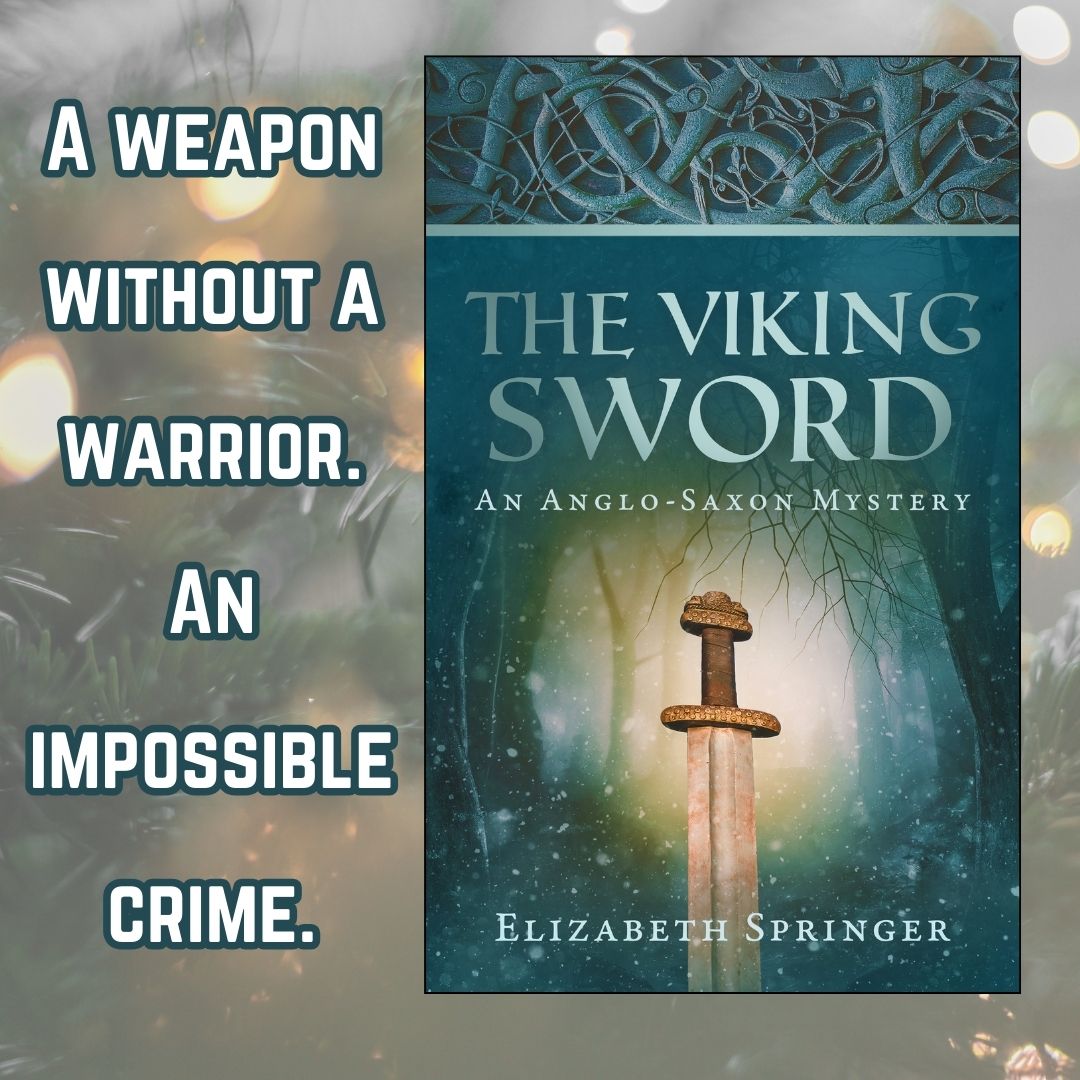
Yule has remained a synonym for Christmastime in English ever since. In Scandinavia, it is the only name for Christmas! The name for the Christian holiday attested during Edwin and Molly’s time is Middewinter. The name Cristesmaesse appears in Old English documents around the year 1000. In The Viking Sword, I alternated these names as a compromise between historical authenticity and the desire to evoke the strong seasonal associations of modern readers with the word Christmas.
Fact and Fiction
So you see my predicament. As I worked on The Viking Sword, I found myself in the same situation as when I had to portray Edwin and Molly’s wedding in A Council of Wolves—there is a distinct lack of source material about how these special days were celebrated. What’s an author to do? Scholarly and popular history writing is full of ‘maybes’ and ‘might haves’ concerning how Christmas was celebrated so long ago, and that is entirely proper. But when you are writing a novel, you have to weigh the ‘maybes’ and ‘might haves,’ and decide on something for your characters to do in the world you have created for them. With this in mind, I included a few seasonal traditions that seemed most likely to have been followed in the ninth century.

Yule logs
The Yule log seems like a very ancient tradition, and it may very well be, but I was surprised to find out that there’s no firm evidence one way or the other. The first written reference in English to a special log that is burned at Christmas dates to 1648, when the poet Robert Herrick mentions a ‘Christmas log,’ and the term ‘Yule log’ appears in other sources around the same time. However, the tradition of having a massive log that you light at midnight on Christmas Eve is a tradition found throughout Europe. As a scholar, I could not make a convicing case from the existing source material that the Anglo-Saxons certainly had a Yule log tradition. As a historical novelist, however, I saw no reason why they should not have one, since the Yule log is such a long-standing and widespread custom. And since holly and ivy are the principal native evergreens in England, I allowed the Anglo-Saxon halls in the novel to be decked with them, though there is no explicit evidence that I know of for that, either.

The Advent fast was broken on Christmas Day when the twelve days of Christmas began. Some of the days within the twelve-day feast had their own dedication or significance: the 26th was St. Stephen’s Day, the 27th was the feast of St. John, the 28th was Childermas (Feast of the Holy Innocents), the 31st was St. Sylvester’s Day, and the 1st of January was the feast of Christ’s circumcision, as it falls eight days after the 25th.
Anytime between Christmas Day and Epiphany (January 6) may have been the traditional time to give gifts. In the eighth century, Ecgbert, Bishop of York wrote that the English customarily gave alms to monasteries and to the poor before and during the twelve days of Christmas. A king such as Alfred didn’t just give to monasteries at Christmas—he gave two monasteries to his friend Bishop Asser, along with a silk cloak and a quantity of incense weighing the same as a man (Asser’s Life of King Alfred, par. 81). Christmas is also a common date on charters, so apparently the king and court got some business done as well while they were all together in one place. The celebrations continued until Epiphany, the traditional date when the visit of the Magi to the infant Christ was celebrated (see Matthew chapter 2).
Which brings me to the Kings’ Cake eaten at the end of The Viking Sword. This cake is to celebrate the arrival of the Three Kings in Bethlehem. (The Bible speaks of an unspecified number of wise men, or as Aelfric calls them, tungel-witegan, ‘star-wise-men,’ bearing three gifts of prophetic significance for the baby Jesus.)
The King Cake tradition is said to derive from Saturnalia, the ancient Roman winter holiday when masters and servants traded places for a week of madcap highjinks and shenanigans. Typically, some small inedible item is hidden in the King Cake. Whoever gets the item—a coin, a bean, a plastic baby—either receives some benefit or privilege, like good luck or getting to be the Lord of Misrule (hence the Saturnalia connection), or has some duty, like buying the King Cake for the office next year. King Cake, also called Twelfth-night Cake, is documented as an English tradition from the Middle Ages into the 18th century, but died away during the Industrial Revolution. It is still popular in continental European countries and in my father’s home state of Louisiana. The “holiday cake with hidden prize” tradition survives in some British family traditions in which a coin is hidden in the Christmas cake or pudding. This tradition has given rise to at least one great British mystery story, “The Adventure of the Christmas Pudding” by Agatha Christie (dramatized as The Theft of the Royal Ruby in 1990).

Because of the Louisiana connection, I have always associated King Cake with Mardi Gras (known in England as Shrove Tuesday or Pancake Day). This is the day before Ash Wednesday, the beginning of the Lenten fast, forty days before Easter—a different season and holiday altogether! Pleasure-loving Louisianians consider King Cake season to stretch from Epiphany until Mardi Gras. That gives everyone in the state plenty of time to enjoy this indulgent seasonal treat.
Back to Christmas in the days of King Alfred. Though I write fiction, I want to portray the history and culture of ninth-century Wessex as accurately as possible. I have had to sift through the bare bones of information available from the period, piece together what is likely based on surviving customs, and breathe life into these relics using my own experience about what people consider to be appropriate to a special life celebration or holiday.
Almost everywhere in the world on such occasions there will be special food and drink, special religious observances and music, a change of home decorations and clothing, exchange of gifts, and shared family rituals or traditions like dancing and games. If all the expected elements are included, people have a sense of a holiday properly celebrated, everyday routine suspended, a moment in the year marked. Strong feelings may be stirred if a cherished tradition is neglected, or if a person has to miss an event while others celebrate. In my portrayal of Edwin and Molly’s first Christmas together, I’ve tried to imagine how Anglo-Saxon people would feel about little details of the holiday and what they would find most meaningful. I hope this aspect rings true, and helps you, the reader, enter deeper into the story. The choice to set The Viking Sword at Christmas has given me a whole new appreciation of Christmas and how it was celebrated in the past, and I’m glad to have the opportunity to share this appreciation with you.
 Elizabeth Springer, Author