Murder in Anglo-Saxon England by Annie Whitehead: Author Interview

In this post, I interview author and historian Annie Whitehead about her new study of historical Anglo-Saxon murders. When I saw this book was coming out, I had to buy and read it!

Elizabeth Springer: Give a brief description of your latest book, Murder in Anglo-Saxon England.

Annie Whitehead: When I’m writing and researching I’m always aware of the more famous, or should I say notorious, murder stories from the period, and I decided it would be fun to investigate all the tales I could find, to see whether they are based on fact, and why later chroniclers might have embellished them. So this is a collection of those stories, which I decoded as much as possible to see if they are true. I also looked at the justice system, the notion of ‘blood feud’, and I thought about a number of recorded deaths which were so timely that I wondered if those who stood most to benefit from them were actually culpable.

ES: Tell a little about your background. How did you become interested in Anglo-Saxon England? About this particular book: what was your inspiration? Tell me about your methods and sources.

AW: I’m a history graduate and Fellow of the Royal Historical Society. I write both fiction and nonfiction books and short stories. I’ve always been interested in history, probably stemming from the time I lived in York when I was eight—there is so much rich history there. I think this latest book was the logical next step for me in terms of nonfiction, as I’d already written a history of the ancient kingdom of Mercia, and a book about the women of the era. Both of these contain some of the murder stories and I decided that they, along with many others, warranted a revisit and further analysis. I always start the research with the earliest contemporary sources and make my way forwards from there. The later the chronicle, the more detail, but also the more exaggeration, so I have to be careful when I’m searching for the facts.

ES: The book could have been called “Political Assassinations in Anglo-Saxon England.” Why do the sources focus on murders of prominent people?

AW: The sources only mention the higher ranks of society, which is frustrating. I have included some chapters about laws (which technically applied to everyone, although the nobility do seem to have murdered with impunity at times) and about execution cemeteries. I found a few legal cases which pertained to lower-ranking nobility, but sadly the common people were not given the same attention by the chroniclers.

ES: Tell about wergild. What was it? What was its purpose?

AW: Wergild was essentially ‘man-price’, a figure based on one’s place in society, and the value placed on one’s life, payable to kin in the event of a killing. If the murderer couldn’t pay, then the lord, or the perpetrator’s kin, were liable, so in a way it was designed to stop such things happening.

ES: Why was Anglo-Saxon law more focused on theft than murder?

AW: I think it has always been thus, and seems to have been true even up to Victorian times, when children were being hanged for theft. It is possible to argue that murder wasn’t a priority because it wasn’t prevalent, although we can’t know as in the main we do only have the high-profile cases, but theft, of land, and property, and particularly house-breaking was a concern, with harsh punishment.

ES: What sources do we have for the types of punishment? What were they?

AW: In terms of the death penalty, the method was usually hanging, although there is evidence of beheading, too. Our sources are archaeological, but also we have written laws from the period which set out in great detail the punishment for various crimes. By and large the punishment system was based on the wergild, and it was a compensation system, with fines laid out for even the most minor injuries to major wounding, again, in an effort to stop fights escalating; everyone knew where they stood and what they would stand to lose if they broke the law. I say ‘everyone’ but again I must say that the higher ranks often got away with it.

Convict on the gallows, from British Library MS Royal 6 E VI f. 444, c. 1375.

ES: Tell us about different methods of murder in the book.

AW: There is such a variety: an assassination attempt with a poisoned blade, child murders, ambushes (quite often a betrayal by a family member or friend, who would lure the victim into the woods under the false promise of a hunting trip), poison (women in particular were accused of poison), witchcraft, and even death by scissors! We also have murders sanctioned by kings, from mass murder to individual assassinations. There’s an examination of the myths and legends surrounding the Blood Eagle, and of the notion of blood feud, extending across generations.

ES: What is forcible tonsure, and why did it exclude the recipient/victim from kingship?

AW: Forcible tonsure (the shaving of the head in the manner of monks) was common, not only in England but also on the Continent, and we hear of it often, particularly in the earlier part of the period. Essentially it meant forcing someone, a rival claimant to the throne, to become a tonsured monk. As a tonsured monk or clergyman, he forfeited his property, mobility, and right to marry, and was thus ineligible to rule. It was a neat way of eliminating his claim without actually killing him.

ES: Do you have a favorite murder story in the book? Are there any you think would make a good plot for a detective novel? Asking for a friend…

AW: One of my favourites concerns an abbess, daughter of a king, who was reputedly jealous that her young brother (a child) succeeded their father. She arranged to have him murdered, but was found out when his soul flew up in the form of a dove which dropped a message on an altar in Rome saying what had happened and where the body could be found. When the funeral procession came back to the abbey, she chanted a spell, but her eyeballs fell out. I love this story because of the gory and frankly fantastic detail, but also because we actually have little to no evidence that her little brother even existed. It’s a classic case of embroidering by the later chroniclers.
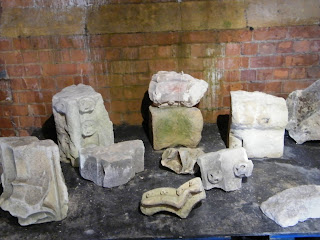
Anglo-Saxon stonework from Winchcombe Abbey, scene of the alleged eyeball incident. Photo: Annie Whitehead.

I’m not sure about murder mystery as a plot for detective novels because when murders are recorded, the chroniclers name the culprit. But it would be interesting for a medieval detective to go off in search of hard evidence that would exonerate them, because in many of the cases I’ve looked at for the book, the evidence for their guilt is not compelling.

[Elizabeth Springer comments: Great idea! The little wheels are turning in my head already…]

ES: What surprised you in your research?

AW: I think one surprise, or at least a realisation, was the extent to which murder went unpunished. We have many cases where we have details of punishment, and high-profile cases of wergild being paid, but far more where no one was held accountable. It was also interesting that one was more likely to die for theft than murder, something I hadn’t really noted before I started writing the book.

ES: You’ve written quite a few books, both fiction and non-fiction. What topics have you written about? Where can readers purchase your books?

AW: I’ve written four novels featuring prominent Mercian characters, including Æthelflæd, Lady of the Mercians, and Penda, the last pagan king. I’ve also written three nonfiction books, one about the history of Mercia, one about women of the era, as well as Murder in Anglo-Saxon England. I’ve also contributed to two nonfiction anthologies and three fiction collections, with another due out later this year.

Details of all my work and where to buy can be found on my website: https://anniewhiteheadauthor.co.uk/
or on my Amazon Author Page: http://viewauthor.at/Annie-Whitehead

ES: What’s next in your writing career?

AW: I’ve gone back to work on a novel that I shelved while writing and researching Murder in Anglo-Saxon England. It’s set in the tenth century, features Anglo-Saxons and Vikings, and has a murder or two. I have an idea for a sequel, too, so I think I’ll be busy for a while.

Favorite Authors Series: Snorri Sturluson

This series features some of my favorite historical fiction and mystery authors.

The cover of the Norwegian translation of Heimskringla by Gustav Storm, published 1900. The entire book is a work of art.

Snorri Sturluson (1178/9-1241) belongs in my series of favorite authors as a pioneer of what might be called biographical historical fiction, and as a poet and teacher of poets. As such, he serves in this series as my figurehead for a whole ‘school’ of now-anonymous saga writers of medieval Iceland, who took the characters, events, and landscapes of Iceland’s recent past and created remarkable prose narratives that deserve to be considered early historical fiction.

What is a saga?
The word ‘saga’ is bandied about quite a bit. What do I mean by an Icelandic saga? The Oxford English Dictionary defines a saga as “any of the narrative compositions in prose that were written in Iceland or Norway during the middle ages.” The second definition suggests transference of meaning: “a narrative having the (real or supposed) characteristics of the Icelandic sagas; a story of heroic achievement or marvellous adventure.”

The king’s men bring their loot aboard. From Gustav Storm’s Norwegian translation of Heimskringla (1900).

An Icelandic saga is a long-form prose narrative, about the length of a modern novel or novella, that tells a story about a person or group of people. The word ‘saga’ is taken from Old Norse and means, approximately, ‘that which is said,’ suggesting that these narratives were once oral tales; but those days were already passing when the sagas were written down as intentional works of literary art. Although the authors make an attempt to portray historical characters and events in a way that would have been recognized as true and reliable by their audience, the fabric of a saga narrative is also an imaginative product, and that’s why I have called it ‘historical fiction’ here. The sagas are written in an objective style and tend to focus on outward actions with minimal authorial commentary. The interpretation of characters’ inner feelings and motives is usually left to the reader. There are different sub-genres of sagas: the ‘sagas of Icelanders’ or Icelandic family sagas tell the story of several generations of a family, usually centering on one person or key event. Kings’ sagas (of which Snorri wrote many) tell the story of a king; most of these are about kings of Norway. There are bishops’ sagas, saints’ sagas, and mythological and legendary sagas based on Germanic legend and contemporary Arthurian romance.

Tempestuous times in Viken.

About Snorri
As he emerges from historical sources, Snorri Sturluson was a multi-faceted man; but he had two main sides, the political and the literary. He lived during a tempestuous time in Iceland’s history, when internal dissension led to a power vacuum soon filled by Norway (this was Norway’s historical moment of being a colonial power). He was a member of the powerful Sturlung family, the richest man in the country, and consequently was propelled to the top of the Icelandic political ladder, becoming law-speaker (leader of the national assembly) while still in his thirties. He married the richest woman in Iceland and they had several children.
On the literary side, he was brought up among the Oddaverjar, a family of chieftains whose farm Oddi was a center of learning. Surely it was here that he developed the literary talents that later led to composition of his series of sixteen sagas of the Norwegian kings (known collectively as Heimskringla) and his prose Edda. He may have written other sagas as well, but authorship of other surviving works is uncertain.

Heimskringla

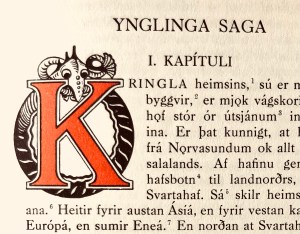
The beginning of Heimskringla, “Kringla heimsins,” from the first volume of the Islenzk Fornrit edition. This is the original Old Norse language in which sagas were written.

The title Heimskringla, which means ‘the circle of the world,’ is taken from the first word in the book. This is not one saga but a collection of sagas of varying lengths, each taking as its main character one of the Norwegian kings. It begins in legendary times with the Saga of the Ynglings and ends with the Saga of Magnús Erlingsson in the late twelfth century. The centerpiece and longest saga is the Saga of St Óláf, which takes up the middle third of the collection. As you might expect, Heimskringla is full of battles and adventures, but you also find lots of details about everyday life, courtship and etiquette, travel, folklore, and humor.

Saint Óláf’s Saga (Heimskringla), Chapter 85
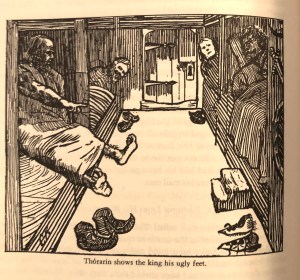
There was a certain man called Thórarin Nefjólfsson. He was an Icelander whose kin lived in the northern quarter of the land. He was not of high birth, but he had a keen mind and was ready of speech. He was not afraid to speak frankly to men of princely birth. He had been on long journeys as a merchant and had been abroad for a long time. Thórarin was exceedingly ugly, and particularly his limbs. He had big and misshapen hands, but his feet were uglier even by far. At the time when the occurrence told above took place, Thórarin happened to be in Tunsberg. King Óláf knew him and had spoken to him. He was getting the merchant ships he owned ready for sailing to Iceland in the summer. King Óláf had invited Thórarin to stay with him for a few days and used to converse with him. Thorarin slept in the king’s lodgings.
One morning early the king awoke while other men were still asleep in the lodgings. The sun had just risen, and the room was in broad daylight. The king observed that Thórarin had stuck one of his feet outside of the bed-clothes. He looked at the foot for a while. Just then the other men in the lodging awoke.
The king said to Thórarin, “I have been awake for a while, and I have seen a sight which seems to me worth seeing, and that is, a man’s foot so ugly that I don’t think there is an uglier one here in this town.” And he called on others to look at it and see whether they thought so too. And all who looked at it agreed that this was the case.
Thórarin understood what it was they talked about and said, “There are few things so unusual that their likes cannot be found, and that is most likely true here too.”
The king said, “I rather warrant you that there isn’t an equally ugly foot to be found, and I would even be willing to bet on that.”
Then Thórarin said, “I am ready to wager with you that I can find a foot here in town which is even uglier.”
The king said, “Then let the one of us who is right ask a favor from the other.”
“So let it be,” replied Thórarin. He stuck out his other foot from under the bed-clothes, and that one was in no wise prettier than the other. It lacked the big toe. Then Thórarin said, “Look here, sire, at my other foot. That is so much uglier for lacking a toe. I have won.”
The king replied, “The first foot is uglier because there are five hideous toes on it, whilst this one has only four. So it is I who has the right to ask a favor of you.”
Thórarin said, “Precious are the king’s words. What would you have me do?”

The English translation of Heimskringla by Lee M. Hollander includes many of the Norwegian woodcut illustrations.

Snorri’s Edda
Interspersed in many of the sagas are snatches of poetry of a very special kind that are used by the saga authors as references or historical sources. This poetry was composed by skalds, professional poets who often served in the court of a nobleman or king. The structure of a skaldic poem is very intricate—I won’t try to explain the finer points here. The verses were made up of convoluted metaphors called kennings. When you compose with kennings, nothing is called by its own name: gold might be called ‘the crucible’s load,’ since it is refined in a crucible, and a man’s arm might be ‘the falcon’s perch,’ since in falconry you carry the bird on your arm. Thus, if a skald wanted to praise a ruler for generously handing out golden arm-rings to his retainers, he might say the ruler was a giver of the crucible’s load to adorn the falcon’s perch. Many of these kennings, however, have built-in references to Norse mythology. In the Christianized time and place in which Snorri lived, myth-based kennings were losing their meaning and devolving into nonsense for young poets.

Gylfi with High, Just-As-High, and Third, from the Uppsala manuscript of Snorri’s Edda, Uppsala University Library, DG 11, f. 26v.

Snorri wrote his Edda to explain Norse mythology and how to use it in kennings in skaldic poetry. It falls into four main parts: the Prologue, which explains how Norse mythology joins up with Genesis and Greek learning; Gylfaginning (The tricking of Gylfi), framed as a sort of fairy tale in which a mythical King Gylfi of Sweden goes on a journey and comes to a hall presided over by three mysterious kings called High, Just-As-High, and Third. He questions them and their answers are stories from Norse mythology. The third section, Skáldskaparmál, explains how kennings work and how to use them. It also contains many important myths, provided as explanations for why certain kennings exist. These two sections are our chief sources for knowledge about Norse mythology. All the Norse myths you have ever read in your life come from these sections of Snorri’s Edda and from the Poetic Edda, an anonymous collection of mythological poems. The fourth section of Snorri’s Edda, Hattatál, is a sampler of different verse forms and how they are composed.

Recommended reading
I recommend Anthony Faulkes’ translation of Snorri’s Edda, published by Everyman.
Heimskringla is available in a good translation by Lee M. Hollander (University of Texas Press) with many of the original woodcuts by various artists from the classic Norwegian translation by Gustav Storm published in 1900.
A selection of anonymous Icelandic sagas. There are many more, but these are some of the most famous:

Egils Saga, trans. Christine Fell and John Lucas, Everyman. (The Penguin translation is also good, but Christine Fell was one of my professors at Nottingham, so I have a particular affection for hers.)

Njal’s Saga, trans. Magnus Magnusson and Hermann Pálsson, Penguin.
The Vinland Sagas: The Norse Discovery of America, trans. Magnus Magnusson and Hermann Pálsson, Penguin.
Hrafnkel’s Saga and Other Stories, trans. Hermann Pálsson, Penguin.
The Saga of the Volsungs, trans. Jesse Byock, Hisarlik Press.

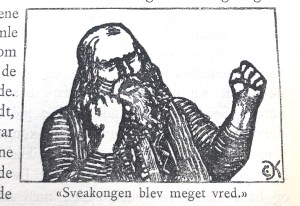
Read a saga, or risk the King of Sweden’s anger!

My Love Affair with Ordnance Survey Maps

Close-up from popular edition Ordnance Survey map of Wimborne and Ringwood, 1925. Photo by author.

“After you left I sent down to Stamford’s for the Ordnance map of this portion of the moor, and my spirit has hovered over it all day. I flatter myself that I could find my way about.” – Sherlock Holmes, The Hound of the Baskervilles

I first became acquainted with Ordnance Survey Maps during my years working at the English Place-Name Society. In the back room there was a large cabinet with a lot of wide, shallow drawers where the maps were kept, pristine and protected, ready for visiting scholars to pull out and spread on a big table for study. This was an important collection of older maps that reflected the names and topography of the historical periods relevant to place-name studies.

Ordnance Survey Maps were, and still are, produced by Ordnance Survey, the national mapping agency for Great Britain. The origins of this agency go back to the Jacobite rising of 1745, when the forces of King George II lacked the detailed maps they needed to find and root out Scottish supporters of Bonnie Prince Charlie (Charles Edward Stuart). In 1747, military officers were charged by the king to make a survey of the Scottish highlands at a scale of 1 inch to 1000 yards. It was soon obvious that having good maps of all parts of Britain would be advantageous for a variety of reasons, so as surveying instruments advanced, the mapping campaign continued. The first maps of the southern counties were published in 1801; the other counties followed in succeeding decades. To allow my spirit to hover over Anglo-Saxon England, I like to use these Old Series or First Edition Ordnance Survey Maps, which show Britain before the changes brought about by the railways.  

The Old Series, as well as other series and maps, can be accessed freely on the internet via www.visionofbritain.org.uk. The resolution is very good, and you can zoom in closely to see the tiniest details. You can also toggle around onto different sheets of the series without having to exit and click on another file.

Sometimes, though, hovering in spirit over a virtual map is too distant a remove; you need to have a physical map spread out before you. Copies of old maps can also be downloaded and taken to a local printer to be printed on a large sheet of paper. Several years ago, my geography-loving son paid $6 of his own money to have a map of Dorset printed for me as a birthday gift. Isn’t it remarkable that we like to give and receive gifts that reflect a shared interest?

I also have a 1925 Popular Edition map of Wimborne and Ringwood that I found on Ebay. It is paper backed with cloth, one inch to one mile, printed in beautiful colors and incredibly fine detail.

It’s easy to take maps for granted. We forget that accurate maps bring together a wealth of different kinds of data. The Ordnance Survey maps used scientific measurements from an instrument known as a theodolite to accurately measure the land. However, the mapping also required crews of trained cartographers to record houses, churches, rivers, hills, swamps, farm fields, surviving Roman roads, and Iron Age tumuli in every corner of the land. They tramped out to remote villages before the age of rail travel to write down place-names according to local spellings. They did this in all seasons and weathers, year after year. Thanks to them, Sherlock Holmes and I can hover over our chosen parts of the country in spirit, and imagine what villainy might be lurking there.