Murder in Anglo-Saxon England by Annie Whitehead: Author Interview

In this post, I interview author and historian Annie Whitehead about her new study of historical Anglo-Saxon murders. When I saw this book was coming out, I had to buy and read it!

Elizabeth Springer: Give a brief description of your latest book, Murder in Anglo-Saxon England.

Annie Whitehead: When I’m writing and researching I’m always aware of the more famous, or should I say notorious, murder stories from the period, and I decided it would be fun to investigate all the tales I could find, to see whether they are based on fact, and why later chroniclers might have embellished them. So this is a collection of those stories, which I decoded as much as possible to see if they are true. I also looked at the justice system, the notion of ‘blood feud’, and I thought about a number of recorded deaths which were so timely that I wondered if those who stood most to benefit from them were actually culpable.

ES: Tell a little about your background. How did you become interested in Anglo-Saxon England? About this particular book: what was your inspiration? Tell me about your methods and sources.

AW: I’m a history graduate and Fellow of the Royal Historical Society. I write both fiction and nonfiction books and short stories. I’ve always been interested in history, probably stemming from the time I lived in York when I was eight—there is so much rich history there. I think this latest book was the logical next step for me in terms of nonfiction, as I’d already written a history of the ancient kingdom of Mercia, and a book about the women of the era. Both of these contain some of the murder stories and I decided that they, along with many others, warranted a revisit and further analysis. I always start the research with the earliest contemporary sources and make my way forwards from there. The later the chronicle, the more detail, but also the more exaggeration, so I have to be careful when I’m searching for the facts.

ES: The book could have been called “Political Assassinations in Anglo-Saxon England.” Why do the sources focus on murders of prominent people?

AW: The sources only mention the higher ranks of society, which is frustrating. I have included some chapters about laws (which technically applied to everyone, although the nobility do seem to have murdered with impunity at times) and about execution cemeteries. I found a few legal cases which pertained to lower-ranking nobility, but sadly the common people were not given the same attention by the chroniclers.

ES: Tell about wergild. What was it? What was its purpose?

AW: Wergild was essentially ‘man-price’, a figure based on one’s place in society, and the value placed on one’s life, payable to kin in the event of a killing. If the murderer couldn’t pay, then the lord, or the perpetrator’s kin, were liable, so in a way it was designed to stop such things happening.

ES: Why was Anglo-Saxon law more focused on theft than murder?

AW: I think it has always been thus, and seems to have been true even up to Victorian times, when children were being hanged for theft. It is possible to argue that murder wasn’t a priority because it wasn’t prevalent, although we can’t know as in the main we do only have the high-profile cases, but theft, of land, and property, and particularly house-breaking was a concern, with harsh punishment.

ES: What sources do we have for the types of punishment? What were they?

AW: In terms of the death penalty, the method was usually hanging, although there is evidence of beheading, too. Our sources are archaeological, but also we have written laws from the period which set out in great detail the punishment for various crimes. By and large the punishment system was based on the wergild, and it was a compensation system, with fines laid out for even the most minor injuries to major wounding, again, in an effort to stop fights escalating; everyone knew where they stood and what they would stand to lose if they broke the law. I say ‘everyone’ but again I must say that the higher ranks often got away with it.

Convict on the gallows, from British Library MS Royal 6 E VI f. 444, c. 1375.

ES: Tell us about different methods of murder in the book.

AW: There is such a variety: an assassination attempt with a poisoned blade, child murders, ambushes (quite often a betrayal by a family member or friend, who would lure the victim into the woods under the false promise of a hunting trip), poison (women in particular were accused of poison), witchcraft, and even death by scissors! We also have murders sanctioned by kings, from mass murder to individual assassinations. There’s an examination of the myths and legends surrounding the Blood Eagle, and of the notion of blood feud, extending across generations.

ES: What is forcible tonsure, and why did it exclude the recipient/victim from kingship?

AW: Forcible tonsure (the shaving of the head in the manner of monks) was common, not only in England but also on the Continent, and we hear of it often, particularly in the earlier part of the period. Essentially it meant forcing someone, a rival claimant to the throne, to become a tonsured monk. As a tonsured monk or clergyman, he forfeited his property, mobility, and right to marry, and was thus ineligible to rule. It was a neat way of eliminating his claim without actually killing him.

ES: Do you have a favorite murder story in the book? Are there any you think would make a good plot for a detective novel? Asking for a friend…

AW: One of my favourites concerns an abbess, daughter of a king, who was reputedly jealous that her young brother (a child) succeeded their father. She arranged to have him murdered, but was found out when his soul flew up in the form of a dove which dropped a message on an altar in Rome saying what had happened and where the body could be found. When the funeral procession came back to the abbey, she chanted a spell, but her eyeballs fell out. I love this story because of the gory and frankly fantastic detail, but also because we actually have little to no evidence that her little brother even existed. It’s a classic case of embroidering by the later chroniclers.
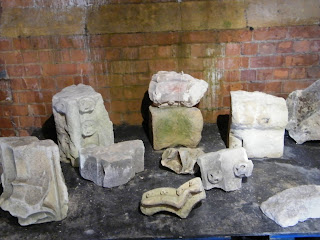
Anglo-Saxon stonework from Winchcombe Abbey, scene of the alleged eyeball incident. Photo: Annie Whitehead.

I’m not sure about murder mystery as a plot for detective novels because when murders are recorded, the chroniclers name the culprit. But it would be interesting for a medieval detective to go off in search of hard evidence that would exonerate them, because in many of the cases I’ve looked at for the book, the evidence for their guilt is not compelling.

[Elizabeth Springer comments: Great idea! The little wheels are turning in my head already…]

ES: What surprised you in your research?

AW: I think one surprise, or at least a realisation, was the extent to which murder went unpunished. We have many cases where we have details of punishment, and high-profile cases of wergild being paid, but far more where no one was held accountable. It was also interesting that one was more likely to die for theft than murder, something I hadn’t really noted before I started writing the book.

ES: You’ve written quite a few books, both fiction and non-fiction. What topics have you written about? Where can readers purchase your books?

AW: I’ve written four novels featuring prominent Mercian characters, including Æthelflæd, Lady of the Mercians, and Penda, the last pagan king. I’ve also written three nonfiction books, one about the history of Mercia, one about women of the era, as well as Murder in Anglo-Saxon England. I’ve also contributed to two nonfiction anthologies and three fiction collections, with another due out later this year.

Details of all my work and where to buy can be found on my website: https://anniewhiteheadauthor.co.uk/
or on my Amazon Author Page: http://viewauthor.at/Annie-Whitehead

ES: What’s next in your writing career?

AW: I’ve gone back to work on a novel that I shelved while writing and researching Murder in Anglo-Saxon England. It’s set in the tenth century, features Anglo-Saxons and Vikings, and has a murder or two. I have an idea for a sequel, too, so I think I’ll be busy for a while.

Cozy?

From my bookshelves: examples of traditional mystery, Golden Age detective fiction, police procedural, cozy mystery, noir, and the one thriller author I really love!

There are lots of different subcategories within crime fiction. The term ‘crime fiction’ itself is an umbrella term, as I recently learned. It encompasses mystery, a story of the process of solving a crime or conundrum, and thriller, a tale of suspense with crime or espionage elements. Carolyn Wheat’s How to Write Killer Fiction compares mysteries to the ‘fun house’ at a fair, where the reader is misdirected, surprised, and presented with situations where things are not as they seem, like the reflections in funny mirrors. Wheat compares the thriller to a roller coaster, where the reader follows the wild ride of the protagonist’s flight or pursuit, dangers, surprises, and upsets.

Mystery readers typically like the intellectual challenge of following the clues and trying to guess ‘whodunit,’ while having the satisfaction of seeing justice done in the end. Thriller readers? No idea, because that’s not me. When I read a thriller, I finish exhausted and temporarily traumatized. Who would do that for fun?

Anyway, within mystery there are still more sub-categories. In my evolution from book shopper and library patron to author, I’ve had to learn about these categories because they affect how your book finds its readers. These categories include police procedural (where the police are the main characters), hardboiled or noir (think The Maltese Falcon), traditional, amateur sleuth, and “cozy.” There are still more permutations—I am condensing here—and of course there is “historical,” which can overlap with any of the above, but be set at a time prior to the author’s present day. All these have unique category codes called BISAC codes that are used by bookshops and libraries to determine how to shelve, group, and promote their titles. Amazon has similar but not identical categories and codes. A book can have more than one code.

My Anglo-Saxon mysteries are coded as historical fiction, medieval historical fiction, historical mystery, and traditional mystery for internet search and metadata purposes. A category I had never considered for them was “cozy mystery.”

But when someone recently described The Viking Sword as a cozy mystery, it brought me up short. I’ve come to suspect that the definition of a cozy mystery may vary quite a lot from one person to another. When you look at the Cozy Mystery section in a bookstore, what you see are titles like Murder and Muffins. The covers are brightly-colored, the title fonts are whimsical, and there is often a cat.

All right, there is a cat in my books as well. There may also be muffins or the Anglo-Saxon equivalent. But…are my books cozy?

Everyone’s favorite online encyclopedia defines the cozy mystery as follows:

Cozy mysteries (also referred to as cozies), are a sub-genre of crime fiction in which sex and violence occur offstage, the detective is an amateur sleuth, and the crime and detection take place in a small, socially intimate community. Cozies thus stand in contrast to hardboiled fiction, in which more violence and explicit sexuality are central to the plot. The term “cozy” was first coined in the late 20th century when various writers produced work in an attempt to re-create the Golden Age of Detective Fiction. […] Cozy mysteries do not employ any but the mildest profanity. The murders take place off stage, frequently involving relatively bloodless methods such as poisoning and falls from great heights. The wounds inflicted on the victim are never dwelt on and are seldom used as clues.

Some of that is true of the Edwin stories—I share the attitude of the kid in the film The Princess Bride with regard to ‘kissing books.’ And since I don’t use profanity myself, I don’t see any reason to take down my characters’ bad language verbatim. Moreover, it’s hard to find any community in the Anglo-Saxon period that was not small and socially intimate. Maybe it’s those aspects that prompted the reader to use the term ‘cozy.’ Reading the Wikipedia description, though, it sounds like some of the sanitized aspects of modern cozies are shaped by the requirements of prime-time network TV. (Confession: I love a good episode of Murder, She Wrote or Death in Paradise, but can’t imagine reading them as novels.)

And my observations here aren’t meant to reflect negatively on the writers or readers of cozy mysteries. Sometimes cozy in the fullest Wikipedia sense is the ideal escape when our days are distinctly un-cozy. Sometimes we are just in the mood for a bit of fun. Sometimes our tolerance levels lean more towards the muffins than the murders. Thank goodness we have so many books to choose from, right? I just wouldn’t want someone to pick up my book as a cozy mystery and be distressed to find rigor mortis and blood stains, and the occasional fight with my protagonist having to strike a fatal blow.

As readers of this blog will know, my inspiration is the Golden Age of detective fiction, roughly the inter-war period of the twentieth century when Agatha Christie, Dorothy L. Sayers, and other great authors defined the mystery genre. The people who were writing and reading during this period were of the World War I generation. The First World War was definitely not one of our more bloodless wars. If you read Golden Age mysteries, you don’t get this sanitized-for-TV treatment of clues. For instance, the first chapter of Sayers’ Have His Carcase is hardly cozy in its treatment of “The Evidence of the Corpse.” Is it a coincidence that in the years after that senseless and tragic conflict, readers yearned for the triumph of the detective and the reasoning ability of the human mind over lawless acts?

I can imagine that the West Saxons of the late ninth century had a similar yearning for the stability of law and the restoration of order. Their homes and livelihoods had repeatedly been at the mercy of the Viking Great Army. They had seen many of their leaders killed in battle, and some had seen fit to change sides and collaborate with the Danes. There were food shortages due to interrupted farm work and trade, and of course the Great Army living off the land. There would have been swathes of the country that were badly affected to one degree or another, and pockets that had remained relatively undamaged. However, the country as a whole was in a state of shock and slow recovery in 879 when the Edwin stories start. I’ve tried to convey that in small ways, such as how characters in the story respond to the thought–ever present as a possibility–of the Vikings coming back, and in their attitudes toward food and clothes.

In another parallel with the World Wars, most of the men of fighting age would have either seen combat or have been required to send young men from their community to serve in the fyrd, the Anglo-Saxon militia or national guard. At home, they all participated in the sort of farmyard bloodshed required in having meat on the table from time to time. Some of my characters ostentatiously glory in the warrior role and find peacetime hard to cope with (like Edwin’s older brother Edmund), while others, like Edwin, do what they must and pay the emotional price later. Some, like Edwin’s retainer Buntel, are physically brave but genuinely squeamish—he excels at hunting and tracking, but wants nothing to do with combat.

Just think of a society like this, the far-off ancestors of the Golden Age detectives, returning from the tumult of the war years to the mundane daily routines of their rural society, and ready to turn their minds to the sort of intellectual puzzle that comes from a good riddle, or a death that’s not easily explained by disease, starvation, or a heathen’s battle-axe.

Authors and readers have to find the right balance (and this will depend on individual experience and temperament) between taking death seriously on the page, and gratuitous descriptions of suffering and gore. The best Golden Age mysteries do have that edge to them, that acknowledgement that death is messy and murder is horrible, but without crossing the line out of consideration for war veterans who may have seen the real thing.

If cozy means a fantasy world where the body is a sort of wax dummy, merely a jumping-off point for a story about some endearing characters and their muffins, that’s not what I want to achieve. I’m reminded of a time when I was talking about books with a friend, and another person—not a reader—joined us at that moment. “Murder mysteries?” she asked, sympathetically. “My cousin was murdered. They never found who did it.”

What do you say to that? Fiction to hard, hard reality in 0.2 seconds. Murder is a genuine family tragedy that leaves a mark for generations. Though it’s fiction, I want my stories to acknowledge that. I never want to make light of crime, but to show that life still has joy, hope returns, and in the end, justice will prevail.

The Viking Sword is out now!

But was this the reason for his feeling of dread? Hard work, dead ends, great effort expended for no result–these were all in a day’s work in a case of the King’s justice. This was something else. He was conscious of a sense of foreboding, as if he was being dragged along by an inexorable Fate, ensnared in a course of events that was building to some terrible climax yet to come.

The Viking Sword, Chapter 5

Today I’m happy to announce the publication of the second book in the Edwin of Wimborne Anglo-Saxon mystery series, The Viking Sword. This novel picks up a few months after A Council of Wolves with Edwin and Molly at home for what they incorrectly think will be a peaceful Christmas holiday.

There are several parallel mysteries in this book, two of which take place in locked rooms, and one involves a murder with a Viking sword. There are some missing treasures, an unexplained skeleton, and a kidnapping. Once again, Edwin composes some riddles as well as solving the crime. I had a lot of fun writing the story and I hope you will enjoy reading it.

The Viking Sword is available to order in paperback and ebook from most retail outlets, and you may also be able to request it from your library.

Amazon US: https://a.co/d/cXAbWLl

Amazon UK: https://amzn.eu/d/gDzh81D

Bookshop.org: https://bookshop.org/contributors/elizabeth-springer

Other ebook retailers such as Apple, Kobo, Barnes & Noble, etc.: https://books2read.com/u/49qzD8

Favorite Authors Series: Snorri Sturluson

This series features some of my favorite historical fiction and mystery authors.

The cover of the Norwegian translation of Heimskringla by Gustav Storm, published 1900. The entire book is a work of art.

Snorri Sturluson (1178/9-1241) belongs in my series of favorite authors as a pioneer of what might be called biographical historical fiction, and as a poet and teacher of poets. As such, he serves in this series as my figurehead for a whole ‘school’ of now-anonymous saga writers of medieval Iceland, who took the characters, events, and landscapes of Iceland’s recent past and created remarkable prose narratives that deserve to be considered early historical fiction.

What is a saga?
The word ‘saga’ is bandied about quite a bit. What do I mean by an Icelandic saga? The Oxford English Dictionary defines a saga as “any of the narrative compositions in prose that were written in Iceland or Norway during the middle ages.” The second definition suggests transference of meaning: “a narrative having the (real or supposed) characteristics of the Icelandic sagas; a story of heroic achievement or marvellous adventure.”

The king’s men bring their loot aboard. From Gustav Storm’s Norwegian translation of Heimskringla (1900).

An Icelandic saga is a long-form prose narrative, about the length of a modern novel or novella, that tells a story about a person or group of people. The word ‘saga’ is taken from Old Norse and means, approximately, ‘that which is said,’ suggesting that these narratives were once oral tales; but those days were already passing when the sagas were written down as intentional works of literary art. Although the authors make an attempt to portray historical characters and events in a way that would have been recognized as true and reliable by their audience, the fabric of a saga narrative is also an imaginative product, and that’s why I have called it ‘historical fiction’ here. The sagas are written in an objective style and tend to focus on outward actions with minimal authorial commentary. The interpretation of characters’ inner feelings and motives is usually left to the reader. There are different sub-genres of sagas: the ‘sagas of Icelanders’ or Icelandic family sagas tell the story of several generations of a family, usually centering on one person or key event. Kings’ sagas (of which Snorri wrote many) tell the story of a king; most of these are about kings of Norway. There are bishops’ sagas, saints’ sagas, and mythological and legendary sagas based on Germanic legend and contemporary Arthurian romance.

Tempestuous times in Viken.

About Snorri
As he emerges from historical sources, Snorri Sturluson was a multi-faceted man; but he had two main sides, the political and the literary. He lived during a tempestuous time in Iceland’s history, when internal dissension led to a power vacuum soon filled by Norway (this was Norway’s historical moment of being a colonial power). He was a member of the powerful Sturlung family, the richest man in the country, and consequently was propelled to the top of the Icelandic political ladder, becoming law-speaker (leader of the national assembly) while still in his thirties. He married the richest woman in Iceland and they had several children.
On the literary side, he was brought up among the Oddaverjar, a family of chieftains whose farm Oddi was a center of learning. Surely it was here that he developed the literary talents that later led to composition of his series of sixteen sagas of the Norwegian kings (known collectively as Heimskringla) and his prose Edda. He may have written other sagas as well, but authorship of other surviving works is uncertain.

Heimskringla

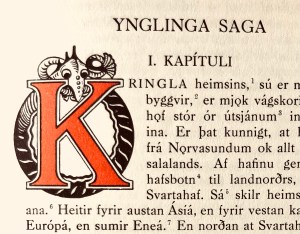
The beginning of Heimskringla, “Kringla heimsins,” from the first volume of the Islenzk Fornrit edition. This is the original Old Norse language in which sagas were written.

The title Heimskringla, which means ‘the circle of the world,’ is taken from the first word in the book. This is not one saga but a collection of sagas of varying lengths, each taking as its main character one of the Norwegian kings. It begins in legendary times with the Saga of the Ynglings and ends with the Saga of Magnús Erlingsson in the late twelfth century. The centerpiece and longest saga is the Saga of St Óláf, which takes up the middle third of the collection. As you might expect, Heimskringla is full of battles and adventures, but you also find lots of details about everyday life, courtship and etiquette, travel, folklore, and humor.

Saint Óláf’s Saga (Heimskringla), Chapter 85
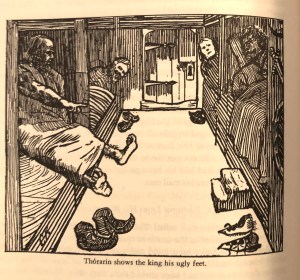
There was a certain man called Thórarin Nefjólfsson. He was an Icelander whose kin lived in the northern quarter of the land. He was not of high birth, but he had a keen mind and was ready of speech. He was not afraid to speak frankly to men of princely birth. He had been on long journeys as a merchant and had been abroad for a long time. Thórarin was exceedingly ugly, and particularly his limbs. He had big and misshapen hands, but his feet were uglier even by far. At the time when the occurrence told above took place, Thórarin happened to be in Tunsberg. King Óláf knew him and had spoken to him. He was getting the merchant ships he owned ready for sailing to Iceland in the summer. King Óláf had invited Thórarin to stay with him for a few days and used to converse with him. Thorarin slept in the king’s lodgings.
One morning early the king awoke while other men were still asleep in the lodgings. The sun had just risen, and the room was in broad daylight. The king observed that Thórarin had stuck one of his feet outside of the bed-clothes. He looked at the foot for a while. Just then the other men in the lodging awoke.
The king said to Thórarin, “I have been awake for a while, and I have seen a sight which seems to me worth seeing, and that is, a man’s foot so ugly that I don’t think there is an uglier one here in this town.” And he called on others to look at it and see whether they thought so too. And all who looked at it agreed that this was the case.
Thórarin understood what it was they talked about and said, “There are few things so unusual that their likes cannot be found, and that is most likely true here too.”
The king said, “I rather warrant you that there isn’t an equally ugly foot to be found, and I would even be willing to bet on that.”
Then Thórarin said, “I am ready to wager with you that I can find a foot here in town which is even uglier.”
The king said, “Then let the one of us who is right ask a favor from the other.”
“So let it be,” replied Thórarin. He stuck out his other foot from under the bed-clothes, and that one was in no wise prettier than the other. It lacked the big toe. Then Thórarin said, “Look here, sire, at my other foot. That is so much uglier for lacking a toe. I have won.”
The king replied, “The first foot is uglier because there are five hideous toes on it, whilst this one has only four. So it is I who has the right to ask a favor of you.”
Thórarin said, “Precious are the king’s words. What would you have me do?”

The English translation of Heimskringla by Lee M. Hollander includes many of the Norwegian woodcut illustrations.

Snorri’s Edda
Interspersed in many of the sagas are snatches of poetry of a very special kind that are used by the saga authors as references or historical sources. This poetry was composed by skalds, professional poets who often served in the court of a nobleman or king. The structure of a skaldic poem is very intricate—I won’t try to explain the finer points here. The verses were made up of convoluted metaphors called kennings. When you compose with kennings, nothing is called by its own name: gold might be called ‘the crucible’s load,’ since it is refined in a crucible, and a man’s arm might be ‘the falcon’s perch,’ since in falconry you carry the bird on your arm. Thus, if a skald wanted to praise a ruler for generously handing out golden arm-rings to his retainers, he might say the ruler was a giver of the crucible’s load to adorn the falcon’s perch. Many of these kennings, however, have built-in references to Norse mythology. In the Christianized time and place in which Snorri lived, myth-based kennings were losing their meaning and devolving into nonsense for young poets.

Gylfi with High, Just-As-High, and Third, from the Uppsala manuscript of Snorri’s Edda, Uppsala University Library, DG 11, f. 26v.

Snorri wrote his Edda to explain Norse mythology and how to use it in kennings in skaldic poetry. It falls into four main parts: the Prologue, which explains how Norse mythology joins up with Genesis and Greek learning; Gylfaginning (The tricking of Gylfi), framed as a sort of fairy tale in which a mythical King Gylfi of Sweden goes on a journey and comes to a hall presided over by three mysterious kings called High, Just-As-High, and Third. He questions them and their answers are stories from Norse mythology. The third section, Skáldskaparmál, explains how kennings work and how to use them. It also contains many important myths, provided as explanations for why certain kennings exist. These two sections are our chief sources for knowledge about Norse mythology. All the Norse myths you have ever read in your life come from these sections of Snorri’s Edda and from the Poetic Edda, an anonymous collection of mythological poems. The fourth section of Snorri’s Edda, Hattatál, is a sampler of different verse forms and how they are composed.

Recommended reading
I recommend Anthony Faulkes’ translation of Snorri’s Edda, published by Everyman.
Heimskringla is available in a good translation by Lee M. Hollander (University of Texas Press) with many of the original woodcuts by various artists from the classic Norwegian translation by Gustav Storm published in 1900.
A selection of anonymous Icelandic sagas. There are many more, but these are some of the most famous:

Egils Saga, trans. Christine Fell and John Lucas, Everyman. (The Penguin translation is also good, but Christine Fell was one of my professors at Nottingham, so I have a particular affection for hers.)

Njal’s Saga, trans. Magnus Magnusson and Hermann Pálsson, Penguin.
The Vinland Sagas: The Norse Discovery of America, trans. Magnus Magnusson and Hermann Pálsson, Penguin.
Hrafnkel’s Saga and Other Stories, trans. Hermann Pálsson, Penguin.
The Saga of the Volsungs, trans. Jesse Byock, Hisarlik Press.

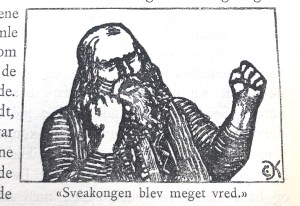
Read a saga, or risk the King of Sweden’s anger!

Favorite Authors Series: Dorothy L. Sayers

This series features some of my favorite historical fiction and mystery authors.

Picture this: It’s the late 1980s, and an American teenage girl is reading the Lord Peter Wimsey mysteries. She and her mother watched the TV series with Edward Petherbridge and Harriet Walter on public television, and have found some of the books in the library. But the girl is puzzled. What is the car case in Have His Carcase? The Five Red Herrings doesn’t have any fish in it, just a bunch of artists and train timetables. And who is this bus driver allegedly having a honeymoon at the same time as Lord Peter in Busman’s Honeymoon? Finally, should she get her hair cut in a 1920s bob like Harriet Vane?

So many questions, and no internet back then for easy answers! But the girl was intrigued by these books and kept reading. Slowly, with persistence, the answers came to these questions and more, leading to a lifelong love of the work of Dorothy L. Sayers (1893-1957).

One of the co-founders in 1930 of the Detection Club, a society of mystery authors that is still in existence today, Sayers was a true original and a fascinating character. She was one of the first female graduates from Oxford University in 1920. She advocated a return to classical education in her 1948 address “The Lost Tools of Learning.” As an advertising copywriter for many years, she understood publicity and led the way in helping her fellow Detection Club authors advertise and sell their books. She abandoned mystery writing during the Second World War and turned to writing plays. She was acquainted with the Inklings, the writing circle of C.S. Lewis and J.R.R. Tolkien. Her Christian theological work The Mind of the Maker is a fascinating analysis of the source of human creativity. She considered her crowning achievement to be her translation of Dante’s Divine Comedy—surely the Mount Everest of translating if there ever was one.

Lord Peter Wimsey, Sayers’ detective, is the younger son of a duke, a First World War veteran, a book collector, monocle wearer, and man-about-town. He masks his keen intellect and physical prowess behind a superficial “Upper-Class Twit of the Year” persona like a sort of 1920s Scarlet Pimpernel. Sayers was struggling to make ends meet when she conceived of her wealthy aristocratic detective and found writing about his lifestyle a great distraction from her own circumstances, as she explained in an essay:

[A]t the time I was particularly hard up and it gave me pleasure to spend his fortune for him. When I was dissatisfied with my single unfurnished room I took a luxurious flat for him in Piccadilly. When my cheap rug got a hole in it, I ordered him an Aubusson carpet. When I had no money to pay my bus fare I presented him with a Daimler double-six, upholstered in a style of sober magnificence, and when I felt dull I let him drive it. I can heartily recommend this inexpensive way of furnishing to all who are discontented with their incomes. It relieves the mind and does no harm to anybody.

Although her books contain a good amount of humor and wit, Dorothy L. Sayers takes her characters seriously. By this I mean she portrays them like real people, not cardboard cut-outs or chess pieces. She allows Lord Peter to suffer from what was then known as shell shock, now referred to as post-traumatic stress disorder. Surely tens of thousands of her readers in the inter-war years, and down to today, can relate to this struggle.

Moreover, she treats death seriously. It is unfortunately all too easy, when you read murder mysteries and watch crime shows on TV, to forget that the story involves the ending of a human life.

Sayers treats human relationships seriously. She is not the only Golden Age author to include romance in her mystery stories, but most other authors limit this to a sub-plot. This is not so with Lord Peter and Harriet Vane. Their relationship is so skillfully portrayed that reading their dialogue is almost like eavesdropping on a couple at the next table in a restaurant. Although my detectives Edwin and Molly are very different from Peter and Harriet, Sayers showed me that you don’t have to choose either a male and female detective for your story—you can have both.

If I had to pinpoint a chink in Sayers’ armor, it would be her plots. To be sure, her plots are elaborate, thoroughly worked-out fair-play detective plots of the Golden Age type, but (perhaps like their contemporaries), they tend to feature very outlandish ways of committing murder. The preposterousness of some of the methods makes a strong contrast with the realism of her characters. The Nine Tailors and Busman’s Honeymoon spring to mind in this regard. I’ve enjoyed all her detective novels, but particular favorites include The Unpleasantness at the Bellona Club (1928), Strong Poison (1930), Murder Must Advertise (1933), and Gaudy Night (1935). She also wrote a good number of mystery short stories, which are a great way to get acquainted with Lord Peter if you have never read any of Sayers’ work before.

And, yes, if you have read A Council of Wolves and were wondering—we chose the name of Edwin’s retainer Buntel (a real Anglo-Saxon name) as a tip of the hat to Lord Peter Wimsey’s valet and assistant, Mervyn Bunter.

Favorite Authors Series: Ellis Peters

This series of blog posts features my favorite mystery and historical fiction authors.

Edith Pargeter (1913-1995) was the author of the Brother Cadfael mystery series. She was born and bred in Shropshire, England. Her long and prolific writing career, beginning in 1936,  included short stories, contemporary crime fiction, historical novels, and historical mysteries under various pseudonyms, including Ellis Peters. She was also a translator. After visiting Czechoslovakia in 1947, she became fluent in Czech and translated Czech literature into English.

I first came in contact with her Brother Cadfael medieval mystery series on a visit to a friend who lived in Shrewsbury. The people there were prodigiously proud of their local mystery author, and I was soon hooked as well.

Three Cadfael books. The book cover on the left has only a few hints of its medieval setting. The other two announce it by referencing the medieval art forms of manuscript illumination and stained glass.

The main character is a Welsh monk at the Benedictine abbey of St. Peter and St. Paul at Shrewsbury during the Anarchy (1138-1153), one of England’s several civil wars. Brother Cadfael is a former crusader, so he has a lot of experience with people, travel, and violent injuries, and he is also an herbalist, so he knows about poison. With these qualifications, he makes a great detective. He becomes friends with the sheriff of Shropshire, and this gives him access to more information and manpower than he would otherwise have. The series addresses many aspects of medieval life and thought, giving the stories great variety. There are twenty books in the series, as well as several short stories. The books progress sequentially with an overall character arc for Cadfael, but they will still make sense if you read them out of sequence.

As a postgrad, I found that all my medieval studies colleagues loved the Cadfael books—almost as a guilty pleasure, because they were so fun to read and had no footnotes or bibliography to get through! Once, one of my friends in the department brought me her box set to read when I was ill.

I was delighted when some of the books were made into a TV series starring Sir Derek Jacobi. Although I love the shows, in my opinion some of the best stories were never filmed. This was probably for budgetary reasons. For instance, the last book, Brother Cadfael’s Penance, involves events in several cities and the siege and capture of a castle.

The first Brother Cadfael book was published in 1977, when historical mysteries were virtually unknown. In fact, this series is credited with popularizing historical mystery as a distinct subgenre. To me, it’s interesting to contrast the early covers of Cadfael books with later versions once the series became popular. At first, it seems, her publisher didn’t know how to market a detective novel set in the Middle Ages, so with these early editions, there is little on the cover that suggests the time period.

Ellis Peters ‘hit the big time,’ as they say, in about 1980, when she had been writing for decades and had finished her third Cadfael book. The catalyst, ironically, was the publication of The Name of the Rose by Umberto Eco. This was a mainstream bestseller, and all of a sudden the reading public was yearning for more medieval mysteries. Now Ellis Peters’ publishers began to lean into the historical aspect of the series, and the book covers reflect the medieval setting. The ‘illuminated manuscript’ covers are the ones I like best. They were the ones I was irresistibly drawn to in a bookshop or library. With a cover like that, you know it’s going to be good.

The Cadfael books are written in a literary style, with fine descriptions of landscape and character. Many readers, including me, love this aspect of Peters’ writing. However, readers accustomed to the more pared-down style of contemporary mystery novels may find her work slow going. Also, Peters writes a little romance sub-plot into each story. Including some star-crossed lovers for Cadfael to help allows Peters to bring out Cadfael’s grandfatherly side and it adds some youthful freshness to the cast of characters.

Ellis Peters will always have a place in my heart. She is an inspiration to me both as a translator (my day job) and as a mystery novelist. In fact, it’s because of Ellis Peters that I am an author today. One day back when we were newlyweds, my husband and I were sitting at the kitchen table talking. One of us said, “The Brother Cadfael books are so good. Too bad there aren’t any mystery novels set in Anglo-Saxon times.” We looked at each other with a wild surmise…and before we knew it, Edwin was born in our imaginations.   Have you read any of the Cadfael books? What did you think?

A Council of Wolves is now available!

A Council of Wolves is now available in paperback and as an ebook from major online retailers. It’s a traditional detective story set in the time of King Alfred in Anglo-Saxon England, with kings, clues, horses and hounds, country houses, swords, spears, and Vikings!

England, AD 879. Called away from his own wedding to accompany his brother on an urgent diplomatic mission for King Alfred of Wessex, the young royal official Lord Edwin of Wimborne becomes suspicious of an “accidental” death that occurs during their stay in neighboring Mercia. As Edwin investigates, he uncovers a tangle of deadly ambitions around the Mercian kingship. Back at home, Edwin’s bride Molly becomes embroiled in events that may have far-reaching consequences as well.

Can Edwin unravel the true course of events in time to save an innocent man and foil a disastrous political plot bolstered by a band of renegade Vikings? When Molly finds the royal estate of Wimborne prey to neglect, embezzlers and seething local discontent, can she turn the tide and make it safe for King Alfred?

Buy on Amazon.com.

Buy on Amazon.co.uk.

For other retailers, click here.

Great news!

My first Anglo-Saxon mystery will be published very soon. Stay tuned!

A Council of Wolves is the first novel in the Edwin of Wimborne mystery series. It will be published soon in paperback and ebook form, and will be available worldwide from your favorite online retailer, or can be ordered from your bookshop or library. Didn’t Hannah Linder Designs do a lovely job on the cover?

British Book Bonanza!

This year I was one of two hundred or so who had the pleasure of attending the Bodies from the Library conference via Zoom. This is an annual conference about Golden Age detective fiction hosted by the British Library. It was very exciting to hear many favorite bloggers and authors, including the authors of books pictured here. Attendees were invited to purchase discounted books from the British Library Bookshop. These were my choices–can’t wait to dive in!