Murder in Anglo-Saxon England by Annie Whitehead: Author Interview

In this post, I interview author and historian Annie Whitehead about her new study of historical Anglo-Saxon murders. When I saw this book was coming out, I had to buy and read it!

Elizabeth Springer: Give a brief description of your latest book, Murder in Anglo-Saxon England.

Annie Whitehead: When I’m writing and researching I’m always aware of the more famous, or should I say notorious, murder stories from the period, and I decided it would be fun to investigate all the tales I could find, to see whether they are based on fact, and why later chroniclers might have embellished them. So this is a collection of those stories, which I decoded as much as possible to see if they are true. I also looked at the justice system, the notion of ‘blood feud’, and I thought about a number of recorded deaths which were so timely that I wondered if those who stood most to benefit from them were actually culpable.

ES: Tell a little about your background. How did you become interested in Anglo-Saxon England? About this particular book: what was your inspiration? Tell me about your methods and sources.

AW: I’m a history graduate and Fellow of the Royal Historical Society. I write both fiction and nonfiction books and short stories. I’ve always been interested in history, probably stemming from the time I lived in York when I was eight—there is so much rich history there. I think this latest book was the logical next step for me in terms of nonfiction, as I’d already written a history of the ancient kingdom of Mercia, and a book about the women of the era. Both of these contain some of the murder stories and I decided that they, along with many others, warranted a revisit and further analysis. I always start the research with the earliest contemporary sources and make my way forwards from there. The later the chronicle, the more detail, but also the more exaggeration, so I have to be careful when I’m searching for the facts.

ES: The book could have been called “Political Assassinations in Anglo-Saxon England.” Why do the sources focus on murders of prominent people?

AW: The sources only mention the higher ranks of society, which is frustrating. I have included some chapters about laws (which technically applied to everyone, although the nobility do seem to have murdered with impunity at times) and about execution cemeteries. I found a few legal cases which pertained to lower-ranking nobility, but sadly the common people were not given the same attention by the chroniclers.

ES: Tell about wergild. What was it? What was its purpose?

AW: Wergild was essentially ‘man-price’, a figure based on one’s place in society, and the value placed on one’s life, payable to kin in the event of a killing. If the murderer couldn’t pay, then the lord, or the perpetrator’s kin, were liable, so in a way it was designed to stop such things happening.

ES: Why was Anglo-Saxon law more focused on theft than murder?

AW: I think it has always been thus, and seems to have been true even up to Victorian times, when children were being hanged for theft. It is possible to argue that murder wasn’t a priority because it wasn’t prevalent, although we can’t know as in the main we do only have the high-profile cases, but theft, of land, and property, and particularly house-breaking was a concern, with harsh punishment.

ES: What sources do we have for the types of punishment? What were they?

AW: In terms of the death penalty, the method was usually hanging, although there is evidence of beheading, too. Our sources are archaeological, but also we have written laws from the period which set out in great detail the punishment for various crimes. By and large the punishment system was based on the wergild, and it was a compensation system, with fines laid out for even the most minor injuries to major wounding, again, in an effort to stop fights escalating; everyone knew where they stood and what they would stand to lose if they broke the law. I say ‘everyone’ but again I must say that the higher ranks often got away with it.

Convict on the gallows, from British Library MS Royal 6 E VI f. 444, c. 1375.

ES: Tell us about different methods of murder in the book.

AW: There is such a variety: an assassination attempt with a poisoned blade, child murders, ambushes (quite often a betrayal by a family member or friend, who would lure the victim into the woods under the false promise of a hunting trip), poison (women in particular were accused of poison), witchcraft, and even death by scissors! We also have murders sanctioned by kings, from mass murder to individual assassinations. There’s an examination of the myths and legends surrounding the Blood Eagle, and of the notion of blood feud, extending across generations.

ES: What is forcible tonsure, and why did it exclude the recipient/victim from kingship?

AW: Forcible tonsure (the shaving of the head in the manner of monks) was common, not only in England but also on the Continent, and we hear of it often, particularly in the earlier part of the period. Essentially it meant forcing someone, a rival claimant to the throne, to become a tonsured monk. As a tonsured monk or clergyman, he forfeited his property, mobility, and right to marry, and was thus ineligible to rule. It was a neat way of eliminating his claim without actually killing him.

ES: Do you have a favorite murder story in the book? Are there any you think would make a good plot for a detective novel? Asking for a friend…

AW: One of my favourites concerns an abbess, daughter of a king, who was reputedly jealous that her young brother (a child) succeeded their father. She arranged to have him murdered, but was found out when his soul flew up in the form of a dove which dropped a message on an altar in Rome saying what had happened and where the body could be found. When the funeral procession came back to the abbey, she chanted a spell, but her eyeballs fell out. I love this story because of the gory and frankly fantastic detail, but also because we actually have little to no evidence that her little brother even existed. It’s a classic case of embroidering by the later chroniclers.
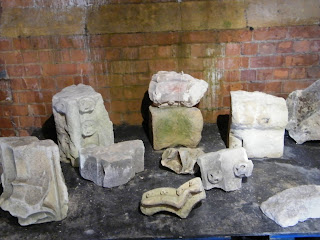
Anglo-Saxon stonework from Winchcombe Abbey, scene of the alleged eyeball incident. Photo: Annie Whitehead.

I’m not sure about murder mystery as a plot for detective novels because when murders are recorded, the chroniclers name the culprit. But it would be interesting for a medieval detective to go off in search of hard evidence that would exonerate them, because in many of the cases I’ve looked at for the book, the evidence for their guilt is not compelling.

[Elizabeth Springer comments: Great idea! The little wheels are turning in my head already…]

ES: What surprised you in your research?

AW: I think one surprise, or at least a realisation, was the extent to which murder went unpunished. We have many cases where we have details of punishment, and high-profile cases of wergild being paid, but far more where no one was held accountable. It was also interesting that one was more likely to die for theft than murder, something I hadn’t really noted before I started writing the book.

ES: You’ve written quite a few books, both fiction and non-fiction. What topics have you written about? Where can readers purchase your books?

AW: I’ve written four novels featuring prominent Mercian characters, including Æthelflæd, Lady of the Mercians, and Penda, the last pagan king. I’ve also written three nonfiction books, one about the history of Mercia, one about women of the era, as well as Murder in Anglo-Saxon England. I’ve also contributed to two nonfiction anthologies and three fiction collections, with another due out later this year.

Details of all my work and where to buy can be found on my website: https://anniewhiteheadauthor.co.uk/
or on my Amazon Author Page: http://viewauthor.at/Annie-Whitehead

ES: What’s next in your writing career?

AW: I’ve gone back to work on a novel that I shelved while writing and researching Murder in Anglo-Saxon England. It’s set in the tenth century, features Anglo-Saxons and Vikings, and has a murder or two. I have an idea for a sequel, too, so I think I’ll be busy for a while.

The Viking Sword is out now!

But was this the reason for his feeling of dread? Hard work, dead ends, great effort expended for no result–these were all in a day’s work in a case of the King’s justice. This was something else. He was conscious of a sense of foreboding, as if he was being dragged along by an inexorable Fate, ensnared in a course of events that was building to some terrible climax yet to come.

The Viking Sword, Chapter 5

Today I’m happy to announce the publication of the second book in the Edwin of Wimborne Anglo-Saxon mystery series, The Viking Sword. This novel picks up a few months after A Council of Wolves with Edwin and Molly at home for what they incorrectly think will be a peaceful Christmas holiday.

There are several parallel mysteries in this book, two of which take place in locked rooms, and one involves a murder with a Viking sword. There are some missing treasures, an unexplained skeleton, and a kidnapping. Once again, Edwin composes some riddles as well as solving the crime. I had a lot of fun writing the story and I hope you will enjoy reading it.

The Viking Sword is available to order in paperback and ebook from most retail outlets, and you may also be able to request it from your library.

Amazon US: https://a.co/d/cXAbWLl

Amazon UK: https://amzn.eu/d/gDzh81D

Bookshop.org: https://bookshop.org/contributors/elizabeth-springer

Other ebook retailers such as Apple, Kobo, Barnes & Noble, etc.: https://books2read.com/u/49qzD8

Three recommended podcasts

Over the past year or so I’ve started listening to podcasts on a regular basis. (This is the silver lining to driving a car without a working stereo.) If you’re interested in Anglo-Saxon England, the Vikings, and historical fiction like I am, these are three that I warmly recommend. Note: when it comes to theme music, one of these podcasts is not like the others….

https://evergreenpodcasts.com/anglo-saxon-england

The Anglo-Saxon England podcast by Tom Kearns has followed the Anglo-Saxon period from the end of the Roman period. Dr. Kearn’s podcasts, which average around 20-25 minutes, each focus on a person or event in the 600-year history of the Anglo-Saxons. Dr. Kearns is careful and methodical, but never dry: his love of the period and people shine through in every episode.

Another great historical podcast is Gone Medieval, hosted by Cat Jarman and Matt Lewis. This podcast covers a wide range of topics within the medieval period, with episodes ranging from 30-60 minutes. The format is often an interview with a scholar highlighting an interesting aspect of medieval life. Vikings come up often. I enjoy the variety and always learn something new.

https://www.youtube.com/@rockpaperswordspodcast

Rock, Paper, Swords! is a podcast by historical fiction authors Matthew Harffy and Steven A. McKay. Matthew Harffy writes action and adventure novels set in Anglo-Saxon times, and Steven A. McKay has two action and adventure series, one about Robin Hood and another about Druids. I love these authors’ good-natured banter, and the energy and humor they bring to their topics and guest interviews.

A Council of Wolves is now available!

A Council of Wolves is now available in paperback and as an ebook from major online retailers. It’s a traditional detective story set in the time of King Alfred in Anglo-Saxon England, with kings, clues, horses and hounds, country houses, swords, spears, and Vikings!

England, AD 879. Called away from his own wedding to accompany his brother on an urgent diplomatic mission for King Alfred of Wessex, the young royal official Lord Edwin of Wimborne becomes suspicious of an “accidental” death that occurs during their stay in neighboring Mercia. As Edwin investigates, he uncovers a tangle of deadly ambitions around the Mercian kingship. Back at home, Edwin’s bride Molly becomes embroiled in events that may have far-reaching consequences as well.

Can Edwin unravel the true course of events in time to save an innocent man and foil a disastrous political plot bolstered by a band of renegade Vikings? When Molly finds the royal estate of Wimborne prey to neglect, embezzlers and seething local discontent, can she turn the tide and make it safe for King Alfred?

Buy on Amazon.com.

Buy on Amazon.co.uk.

For other retailers, click here.

Great news!

My first Anglo-Saxon mystery will be published very soon. Stay tuned!

A Council of Wolves is the first novel in the Edwin of Wimborne mystery series. It will be published soon in paperback and ebook form, and will be available worldwide from your favorite online retailer, or can be ordered from your bookshop or library. Didn’t Hannah Linder Designs do a lovely job on the cover?

Anglo-Saxon Names, Part 2: An Apology

TEST PAPER I

UP TO THE END OF 1066

8. Have you the faintest recollection of

(1) Ethelbreth?

(2) Athelthral?

(3) Thruthelthrolth?

9. What have you the faintest recollection of?

1066 And All That, W.C. Sellar & R.J. Yeatman, 1930

It’s a question every author of a book set in the Anglo-Saxon period has to come to grips with: what to do with the names? Even though Old English, the language of the Anglo-Saxons, is the ancestor of our modern tongue, and many of its words survive in daily use, the same cannot be said of Anglo-Saxon personal names. Very few Anglo-Saxon personal names survive in (sort of) modern usage: examples are Edward, Godfred, Herbert, Baldric, Osmund, Winston.

Women’s names are even more difficult than men’s. The names that have remained in use to the modern age tend to sound antiquated: Bertha, Hilda, Winifred, Edith (Eadgyth), Audrey (a worn-down version of Æðelþryð, believe it or not!).

Anglo-Saxon names took two forms: monothematic (one word or element of meaning), and dithematic (two words or elements of meaning). Monothematic names were more common in the earlier centuries of the Anglo-Saxon period; later they became less common in the upper levels of society, with dithematic names becoming more favored.

Here’s how a dithematic name like Edwin works: Ed- means ‘fortune,’ and -win or -wine means friend, so Edwin’s name actually means ‘fortune’s friend.’ Every name is made from some mix-and-match of elements like this, known as the prototheme and deutorotheme, but the two elements or themes do not always fit together in a meaningful combination.

What was more important, in many cases, was the alliteration. Alliteration is a form of rhyme in which two or three words begin with the same letter. Alliteration works best in Germanic languages like English that have the emphasis on the first syllable. English speakers still instinctively favor alliteration—it just sounds ‘catchy.’ If you don’t believe me, ask Mickey Mouse and Donald Duck.

Since the Anglo-Saxons didn’t have surnames, they used alliteration to show family relationships. Case in point: King Æthelwulf (‘noble wolf’) of Wessex. Æthelwulf’s children were Æthelstan (‘noble stone’), Æthelbald (‘noble-bold’), Æthelswith (‘noble strength’; daughter), Æthelberht (‘noble-bright/noble fame’), Æthelred (‘noble counsel’), and Ælfred (‘elf-counsel’). The royal lines of other Saxon kingdoms used a similar pattern with different repeating elements: Sige- (‘victory’) was favored as a prototheme by the kings of Essex, for example, and Os- (‘pagan god’) by the Northumbrian royal line. A person could also have a byname or nickname, and dithematic names were sometimes shortened with an affectionate diminutive ending.

Fiction and Non-Fiction

Every author or publisher that has to work with Anglo-Saxon names has to make some decisions about how to print them. In scholarly publications, the preference is usually for a standardized West Saxon spelling complete with thorns, eths, ashes, etc. There is an expectation that the reader will be able, or at least willing, to cope.

That’s not necessarily the case for readers of fiction. I enjoy a mystery set in ancient Rome or medieval China, but I’m not a scholar in those areas. I appreciate all the help the author is willing to give me to understand the setting and characters, including their names.

I have seen a variety of different approaches to Anglo-Saxon personal names and place-names in novels set in the period. On the one hand you have books that use the Anglo-Saxon forms wherever possible—even for well-known place-names like London, which becomes Lundenwic. Some readers find it confusing, while others feel that it brings a greater feeling of immediacy and authenticity to the story.

Others try to normalize and shorten even the names of (relatively) well-known historical characters. I remember reading a novel aimed at the youth market that referred to Alfred’s daughter Aethelflaed as Fleda throughout, presumably because it looked more like what modern people would expect of a girl’s name. 

For the Edwin stories, I’ve tried to find a happy medium. I use the modern spelling of English place-names. It seems smoother, less jarring, to read the modern spellings in a line of text written in Modern English. With a slight pang of regret, I decided not to use thorn, eth, and ash, opting instead for the more approachable (I hope) th and ae. Recurring characters like Edwin and Edmund are given more familiar-sounding names. My husband and I found the female name Molgifu in a German book on Anglo-Saxon personal names whose title I have lost track of. I think the name was attested once in written sources, which means it was rare. We seized on it, though, because it gave our female lead a chance to have a readily pronounceable nickname. I gave the Abbess of Wimborne the unmanageable name Eormengyth (Yor-men-gith, approximately), only because I knew I could refer to her as ‘the Abbess’ on most occasions. Finally, please accept my heartfelt apology for Anglo-Saxon personal names. As you have read, I have tried my best to choose easier names for main characters. I have simplified spellings. I have referred to people by their titles or nicknames when possible. I put a list of characters at the beginning of the book for readers to refer back to. However, I can’t give Anglo-Saxons modern names, or change the names of historical figures just because they all start with Aethel. You just have to dive into their world and live by its rules for a little while.

Anglo-Saxon Names, Part 1: A Pronunciation Guide

WAVE OF EGG-KINGS

Soon after this event [the conversion of England] Egg-Kings were found on the thrones of all these kingdoms, such as Eggberd, Eggbreth, Eggfroth, etc. None of them, however, succeeded in becoming memorable—except in so far as it is difficult to forget such names as Eggbirth, Eggbred, Eggbeard, Eggfilth, etc. Nor is it even remembered by what kind of Eggdeath they perished.

—1066 And All That, W.C. Sellar & R.J. Yeatman, 1930

The names: they are the first thing readers notice and remark on about a book set in the Anglo-Saxon period. Most of them sound strange, made up of unexpected groupings of letters. It’s unclear how to pronounce them—even which syllable is supposed to get the stress. And what do you do with a name that starts with Æð ?

Below I’ve provided a simple guide to pronouncing Anglo-Saxon names.

In general, you should pronounce every letter in an Anglo-Saxon name. There are not any silent letters. Emphasis is always on the first syllable.

Vowels:

A as in cart (short) or all (long)

E as in ever (short) or angel (long)

I as in igloo (short) or evil (long)

O as in octopus (short) or over (long)

U as in oops (long)

Æ (upper case) or æ (lower case) is called ash. It is pronounced like the a in ash.

Đ (upper case) or ð (lower case) This letter is called eth and represents a /th/ sound.

Þ (upper case) or þ (lower case) This letter is called thorn and also represents a /th/ sound.

Fun fact: The people of Iceland were originally taught to write by Anglo-Saxon missionaries. As a result, thorn and eth are still used in modern Icelandic. In Icelandic, thorn represents an unvoiced /th/ as in ‘thick’, while eth is used for voiced /th/ as in ‘them.’ In Old English they are used interchangeably for both voiced and unvoiced /th/.

The Mercian characters in the first Edwin story, Aethelwulf and Aethelred, are therefore pronounced Ath-el-wolf and Ath-el-red.

Consonants:

These are pronounced pretty much as in modern English, except for c, h, and g.

C – At the beginning of a word, c is thought to have been pronounced as /ch/, so the name of the Mercian king Ceolwulf would be pronounced Chay-ol-wolf.

H – This letter is pronounced as you would expect, except when it appears next to a t. The h in this -ht combination has a sound like Scottish ‘loch’. It is the origin of our modern -ght at the end of words like ‘night’ and ‘thought’—it used to be a throatier sound. The g was later added to the ht combination by Norman scribes who thought it needed an extra letter.

G – At the beginning of a word, this letter was sometimes pronounced as if the word began with a y. Many of our modern English words that start with a y today (yesterday, yearn, yarn, etc.) were spelled with an initial g in Old English. Elsewhere in the word, g is pronounced as you would expect in Modern English.

There are some consonant pairs that have special pronunciations.

HW – pronounced like modern wh. Sensibly, the Anglo-Saxons put the h first because that’s what sound comes first. It was those pesky Norman scribes that switched them around.

CW – pronounced like modern qu, as in ‘queen’ (Old English cwen). Again, this sensible Anglo-Saxon spelling was changed by Norman scribes.

WR and WL – You pronounce both the letters. Go on, try it!

And what do we do with the wave of Egg-Kings immortalized by that little comedic gem of a book 1066 And All That?

The Egg-Kings really had names beginning with the name element ecg. (More on name elements in the next blog post). The consonant combination cg was pronounced like our /dg/, so what the authors of 1066 remember as “egg” is really “edge”—as in ‘sword’s edge.’ Suddenly these Anglo-Saxon names move from comedy into more of a “military drama” category, don’t they? And if you read your Bede and Anglo-Saxon Chronicle, you’ll see that the Eggdeaths by which they perished were, in fact, more often edge-deaths.

Edwin of Wimborne – the first book

The first Edwin of Wimborne mystery is still in search of a publisher. Sometimes that can be a long process! However, this is what the first book is about. It’s a mystery set in the time of King Alfred featuring the fictional detective couple Lord Edwin and Lady Molgifu (Molly).

England, AD 879. Called away from his own wedding to accompany his brother on an urgent diplomatic mission for King Alfred of Wessex, the young royal official Lord Edwin of Wimborne becomes suspicious of an ‘accidental’ death that occurs during their stay in neighboring Mercia. As Edwin investigates he uncovers a tangle of deadly ambitions around the Mercian kingship. Back at home, Edwin’s bride Molly becomes embroiled in events that may have far-reaching consequences as well. Can Edwin unravel the true course of events in time to save an innocent man and foil a disastrous political plot bolstered by a band of renegade Vikings? When Molly finds the royal estate of Wimborne prey to neglect, embezzlers and seething local discontent, can she turn the tide and make it safe for King Alfred?

My Love Affair with Ordnance Survey Maps

Close-up from popular edition Ordnance Survey map of Wimborne and Ringwood, 1925. Photo by author.

“After you left I sent down to Stamford’s for the Ordnance map of this portion of the moor, and my spirit has hovered over it all day. I flatter myself that I could find my way about.” – Sherlock Holmes, The Hound of the Baskervilles

I first became acquainted with Ordnance Survey Maps during my years working at the English Place-Name Society. In the back room there was a large cabinet with a lot of wide, shallow drawers where the maps were kept, pristine and protected, ready for visiting scholars to pull out and spread on a big table for study. This was an important collection of older maps that reflected the names and topography of the historical periods relevant to place-name studies.

Ordnance Survey Maps were, and still are, produced by Ordnance Survey, the national mapping agency for Great Britain. The origins of this agency go back to the Jacobite rising of 1745, when the forces of King George II lacked the detailed maps they needed to find and root out Scottish supporters of Bonnie Prince Charlie (Charles Edward Stuart). In 1747, military officers were charged by the king to make a survey of the Scottish highlands at a scale of 1 inch to 1000 yards. It was soon obvious that having good maps of all parts of Britain would be advantageous for a variety of reasons, so as surveying instruments advanced, the mapping campaign continued. The first maps of the southern counties were published in 1801; the other counties followed in succeeding decades. To allow my spirit to hover over Anglo-Saxon England, I like to use these Old Series or First Edition Ordnance Survey Maps, which show Britain before the changes brought about by the railways.  

The Old Series, as well as other series and maps, can be accessed freely on the internet via www.visionofbritain.org.uk. The resolution is very good, and you can zoom in closely to see the tiniest details. You can also toggle around onto different sheets of the series without having to exit and click on another file.

Sometimes, though, hovering in spirit over a virtual map is too distant a remove; you need to have a physical map spread out before you. Copies of old maps can also be downloaded and taken to a local printer to be printed on a large sheet of paper. Several years ago, my geography-loving son paid $6 of his own money to have a map of Dorset printed for me as a birthday gift. Isn’t it remarkable that we like to give and receive gifts that reflect a shared interest?

I also have a 1925 Popular Edition map of Wimborne and Ringwood that I found on Ebay. It is paper backed with cloth, one inch to one mile, printed in beautiful colors and incredibly fine detail.

It’s easy to take maps for granted. We forget that accurate maps bring together a wealth of different kinds of data. The Ordnance Survey maps used scientific measurements from an instrument known as a theodolite to accurately measure the land. However, the mapping also required crews of trained cartographers to record houses, churches, rivers, hills, swamps, farm fields, surviving Roman roads, and Iron Age tumuli in every corner of the land. They tramped out to remote villages before the age of rail travel to write down place-names according to local spellings. They did this in all seasons and weathers, year after year. Thanks to them, Sherlock Holmes and I can hover over our chosen parts of the country in spirit, and imagine what villainy might be lurking there.