This series features some of my favorite historical fiction and mystery authors.
Picture this: It’s the late 1980s, and an American teenage girl is reading the Lord Peter Wimsey mysteries. She and her mother watched the TV series with Edward Petherbridge and Harriet Walter on public television, and have found some of the books in the library. But the girl is puzzled. What is the car case in Have His Carcase? The Five Red Herrings doesn’t have any fish in it, just a bunch of artists and train timetables. And who is this bus driver allegedly having a honeymoon at the same time as Lord Peter in Busman’s Honeymoon? Finally, should she get her hair cut in a 1920s bob like Harriet Vane?
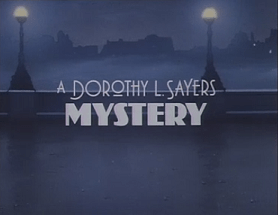
So many questions, and no internet back then for easy answers! But the girl was intrigued by these books and kept reading. Slowly, with persistence, the answers came to these questions and more, leading to a lifelong love of the work of Dorothy L. Sayers (1893-1957).
One of the co-founders in 1930 of the Detection Club, a society of mystery authors that is still in existence today, Sayers was a true original and a fascinating character. She was one of the first female graduates from Oxford University in 1920. She advocated a return to classical education in her 1948 address “The Lost Tools of Learning.” As an advertising copywriter for many years, she understood publicity and led the way in helping her fellow Detection Club authors advertise and sell their books. She abandoned mystery writing during the Second World War and turned to writing plays. She was acquainted with the Inklings, the writing circle of C.S. Lewis and J.R.R. Tolkien. Her Christian theological work The Mind of the Maker is a fascinating analysis of the source of human creativity. She considered her crowning achievement to be her translation of Dante’s Divine Comedy—surely the Mount Everest of translating if there ever was one.
Lord Peter Wimsey, Sayers’ detective, is the younger son of a duke, a First World War veteran, a book collector, monocle wearer, and man-about-town. He masks his keen intellect and physical prowess behind a superficial “Upper-Class Twit of the Year” persona like a sort of 1920s Scarlet Pimpernel. Sayers was struggling to make ends meet when she conceived of her wealthy aristocratic detective and found writing about his lifestyle a great distraction from her own circumstances, as she explained in an essay:
[A]t the time I was particularly hard up and it gave me pleasure to spend his fortune for him. When I was dissatisfied with my single unfurnished room I took a luxurious flat for him in Piccadilly. When my cheap rug got a hole in it, I ordered him an Aubusson carpet. When I had no money to pay my bus fare I presented him with a Daimler double-six, upholstered in a style of sober magnificence, and when I felt dull I let him drive it. I can heartily recommend this inexpensive way of furnishing to all who are discontented with their incomes. It relieves the mind and does no harm to anybody.
Although her books contain a good amount of humor and wit, Dorothy L. Sayers takes her characters seriously. By this I mean she portrays them like real people, not cardboard cut-outs or chess pieces. She allows Lord Peter to suffer from what was then known as shell shock, now referred to as post-traumatic stress disorder. Surely tens of thousands of her readers in the inter-war years, and down to today, can relate to this struggle.
Moreover, she treats death seriously. It is unfortunately all too easy, when you read murder mysteries and watch crime shows on TV, to forget that the story involves the ending of a human life.
Sayers treats human relationships seriously. She is not the only Golden Age author to include romance in her mystery stories, but most other authors limit this to a sub-plot. This is not so with Lord Peter and Harriet Vane. Their relationship is so skillfully portrayed that reading their dialogue is almost like eavesdropping on a couple at the next table in a restaurant. Although my detectives Edwin and Molly are very different from Peter and Harriet, Sayers showed me that you don’t have to choose either a male and female detective for your story—you can have both.


If I had to pinpoint a chink in Sayers’ armor, it would be her plots. To be sure, her plots are elaborate, thoroughly worked-out fair-play detective plots of the Golden Age type, but (perhaps like their contemporaries), they tend to feature very outlandish ways of committing murder. The preposterousness of some of the methods makes a strong contrast with the realism of her characters. The Nine Tailors and Busman’s Honeymoon spring to mind in this regard. I’ve enjoyed all her detective novels, but particular favorites include The Unpleasantness at the Bellona Club (1928), Strong Poison (1930), Murder Must Advertise (1933), and Gaudy Night (1935). She also wrote a good number of mystery short stories, which are a great way to get acquainted with Lord Peter if you have never read any of Sayers’ work before.
And, yes, if you have read A Council of Wolves and were wondering—we chose the name of Edwin’s retainer Buntel (a real Anglo-Saxon name) as a tip of the hat to Lord Peter Wimsey’s valet and assistant, Mervyn Bunter.
 Elizabeth Springer, Author
Love this! I’ll have to check out her books. I’ve never read one.
Hope all is good with you and and your writing. I’m taking a break to refill the well…
Best,
Jen
>
LikeLike